People who are really serious about software should make their own hardware.-Alan Kay
ESP32
MicroPython is a tiny open source Python programming language interpreter that runs on small embedded development boards, like the super cool, small, and very inexpensive esp32 based HUZZAH32.
ESP32 Projects
- Micro Python on ESP32 (HUZZAH32)
- Cuboids – small internet connected devices knowing their orientation in 3D space
- Introducing pyBox
Raspberry Pi
Most recently, I added some Raspberry Pi boards to my ever growing number of embedded platforms to experiment with. While in the same price range as some Arduino boards, the Raspberry Pi is not as easy to integrate into basic embedded projects but is much more powerful and equipped with ethernet, two usb, audio and HDMI out.
Raspberry Pi Projects
- Raspberry Pi – Where to start? A quick look at the Pi’s components, memory split, and boot process.
- Raspberry Pi – WiFi (Edimax EW-7811Un) Creating that bootable SDCard incl. WiFi setup.
- Raspberry Pi – Getting access via Serial Connection 3 ways to access the Pi’s UART TXD/RXD pins.
- Streaming Your Webcam w/ Raspberry Pi
- Raspberry Pi – Speech Recognition on device (SphinxBase and PocketSphinx)
- Raspberry Pi – Translator connecting to speech related services from Google and Microsoft
- Raspberry Pi and Pi-ZERO – Vocal-Emotion Lamp
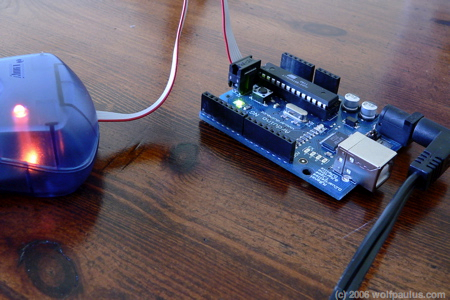
Arduino
Arduino is an open-source computing platform based on a simple board, and a development environment for writing software. The Arduino board hosts an Atmel MicroController chip, the AVR-ATMega8, which has 8-KByte self-programming Flash Program Memory, 1-KByte SRAM, 512 Byte EEPROM, 23 I/O pins, 6 or 8 Channel 10-bit A/D-converter, and 16 MIPS throughput at 16 MHz.
The other IC on the board is an FTDI FT232RL, a single chip USB/Asynchronous serial data transfer solution, with 256 Byte receive and 128 Byte transmit buffer.
Arduino Projects
- Small hack increases available memory by 6.3%
- Doubling Arduino’s amount of Flash Memory
- ATmega 8 / 168 internal clock and fuse settings
- ATmega 328, Doubling Arduino’s Flash Memory Once Again
- The $3 Arduino – Minimal Bare-Bones ATmega168 without Boot-Loader
- Extended list of 8-bit AVR Micro-Controllers, easily programmable with the Arduino IDE